
Learn how to apply for the SASSA SRD grant in 2026, who qualifies, what information is required, how verification works and what to do if your application is declined.
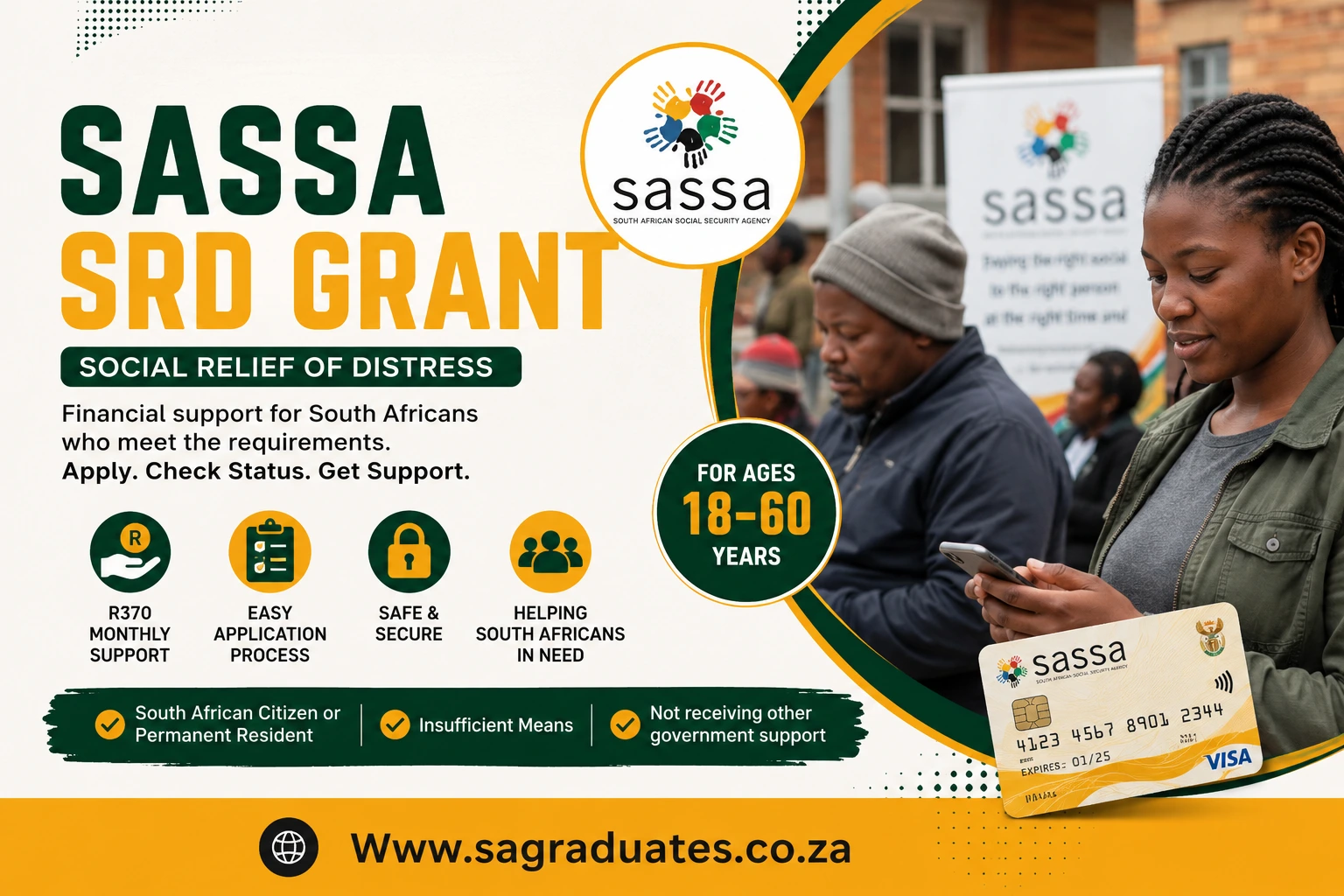
For millions of South Africans without a reliable income, the Social Relief of Distress (SRD) grant remains an important temporary source of financial support. In 2026, the SRD grant continues at R370 per month, with the current extension running from April 2026 to March 2027.
However, applying successfully is about more than simply completing an online form. SASSA checks information against several databases, including banking and government records, meaning inaccurate personal information, incorrect banking details or missed verification requests can affect an application.
This guide explains how to apply for the SASSA SRD grant, what applicants need to understand before applying, how the verification process changes the application experience and what to do when an application is declined.
Also Check our Learnerships
Quick Facts About How to Apply for the SASSA SRD Grant
| Information | Details |
|---|---|
| Closing date | Not stated in the original information |
| Location | South Africa |
| Duration | April 2026 to March 2027 |
| Positions available | Not applicable |
| Reference number | Not stated in the original information |
| Stipend | R370 per month |
| Required Gender | Not stated in the original information |
| Company Name | South African Social Security Agency (SASSA) |
The Department of Social Development announced in February 2026 that the R370 SRD provision would be extended for 12 months, from 1 April 2026 until 31 March 2027.
Original-information advert fields
REQUIREMENTS: Eligibility requirements apply; see the eligibility section below.
DUTIES: Not stated in the original information.
ENQUIRIES: SASSA toll-free: 0800 601 011.
CLOSING DATE: Not stated in the original information.
SALARY: Not applicable.
COMPANY NAME: South African Social Security Agency (SASSA).
NUMBER OF POSTS AVAILABLE: Not applicable.
HOW TO APPLY: Apply online through the official SASSA SRD platform.
1. How to Apply for the SASSA SRD Grant Online
The most important point for anyone researching how to apply for the SASSA SRD grant is to use the official application platform.
The official SASSA SRD website is:
Official SASSA SRD application portal
SASSA’s current SRD portal provides separate routes for South African ID holders and asylum seekers and special permit holders. Applicants must select the option that applies to their circumstances and follow the instructions provided.
The application is electronic. SASSA says applicants need to provide or confirm personal information, a mobile phone number, employment and lifestyle-sustainability information and banking information. The agency also states that applicants do not need to upload documentation as part of the standard electronic application process.
This makes the application process relatively accessible, but it also places greater responsibility on applicants to ensure that the information they submit is correct.
A useful approach is to prepare your information before starting the application. This reduces the possibility of entering incorrect details simply because you are rushing through the form.
2. Who Can Qualify for the SASSA SRD Grant?
Eligibility is one of the most important aspects to understand before applying.
According to SASSA’s official SRD portal, the grant is intended for South African citizens, refugees, asylum seekers and certain special permit holders between 18 and 60 years old who have insufficient means and meet the relevant qualifying conditions.
The 2026 SASSA grant booklet also sets out qualifying criteria, including residence in South Africa, registration on the Department of Home Affairs database and compliance with the applicable means-test requirements.
Applicants must also not be receiving another social grant for themselves and must meet other conditions relating to income, employment and financial support.
This is where many applicants misunderstand the process.
Simply being unemployed does not automatically mean an applicant will be approved. SASSA conducts verification checks to determine whether information supplied by an applicant is consistent with information available from other institutions.
The agency’s privacy information confirms that it obtains verification information from organisations and databases including UIF, SARS, the Government Employees Pension Fund, NSFAS and retail banks.
The implication is important: applicants should regard the SRD application as a verification process rather than merely a declaration of unemployment.
3. Why Your Cellphone Number and Banking Details Matter
One of the strongest practical lessons from recent SASSA guidance is the importance of using accurate contact and banking information.
SASSA has specifically urged SRD applicants to use a cellphone number registered in their own name. The agency explains that the cellphone number is used to communicate with applicants, including for verification requests.
This means applicants should not casually use somebody else’s cellphone number when completing an application.
Banking information is equally important.
SASSA has stated that banking details are crucial to the application and payment process. If banking details do not belong to the applicant, the system may not verify the payment.
From an analytical perspective, this reflects a broader change in how social assistance is administered. Instead of relying primarily on paperwork submitted at an office, the SRD system uses electronic information and cross-checks to establish whether an applicant qualifies.
That makes the system faster and potentially more scalable, but it also means small inconsistencies can have consequences.
Applicants should therefore carefully check: How to Apply for the SASSA SRD Grant
- Their identity information.
- Their cellphone number.
- Their banking information.
- Their employment information.
- Their answers regarding other sources of income or financial support.
Accuracy is more important than speed.
4. Verification Is Now a Central Part of the Application
The biggest misconception surrounding how to apply for the SASSA SRD grant is that submitting an application automatically means the process is finished.
It does not.
The 2026 SASSA grant booklet states that new applicants must complete facial biometric authentication (eKYC) before the grant can be approved. Applicants whose applications are referred may also be required to request a verification link through the SRD portal and complete facial authentication.
SASSA has also explained that applicants who change their cellphone numbers can be required to undergo facial recognition verification. Beneficiaries whose applications show an approved-but-not-paid status may similarly be required to complete verification.
This is significant because it demonstrates that identity verification is not simply an optional security feature.
It is increasingly part of determining whether the correct person is applying for and receiving the grant.
In January 2026, SASSA also said beneficiaries without smartphones, laptops or data could visit local SASSA offices for assistance with biometric identity verification. The agency said offices have tools such as kiosks, laptops and guest Wi-Fi to assist beneficiaries.
For applicants, the practical lesson is straightforward: do not ignore a verification request.
An application can remain unresolved or fail to progress if required verification is not completed.
5. What Happens If Your SRD Application Is Declined?
A declined SRD application does not necessarily mean that there is no further action available.
The official SASSA SRD portal states that applicants have the right to appeal a SASSA decision for each month in which an application is declined.
This is particularly important because SRD applications are assessed using information obtained through verification processes.
For example, SASSA has explained that an application can be declined when the system identifies a source of income through external databases, including information obtained from financial institutions.
An applicant who believes that the decision is incorrect should therefore examine the reason for the decline rather than simply abandoning the application.
The appeal process exists because information used during automated verification can require further consideration.
Applicants should also be careful about repeatedly changing information simply to try to obtain approval. SASSA has previously warned beneficiaries that repeatedly changing banking details and cellphone numbers can delay payment processes.
The better strategy is to correct genuine errors and follow the official process rather than making unnecessary changes.
6. The R370 Grant in the Bigger Economic Picture
The R370 SRD grant is relatively small when compared with household living costs, but its significance should not be judged only by its nominal value.
The 2026 Budget process confirmed that the SRD grant would remain at R370, with the provision extended through March 2027.
This places the grant within a broader cost-of-living challenge facing low-income households.
Parliament’s Parliamentary Budget Office has highlighted the gap between the R370 SRD grant and the cost of essential household expenses, illustrating how the payment functions primarily as a limited safety net rather than a complete income replacement.
This distinction matters.
Someone receiving the SRD grant should not view the payment as equivalent to a salary. Instead, it provides temporary financial assistance while the beneficiary searches for employment, develops an income-generating activity or navigates difficult economic circumstances.
The Department of Social Development has increasingly emphasised the relationship between social assistance and economic participation. In July 2026, SASSA CEO Themba Matlou encouraged young people to consider using the R370 grant as a starting point for income-generating activities and small businesses.
That perspective does not diminish the importance of the grant. Rather, it highlights the policy challenge: temporary assistance can provide immediate relief, but sustainable employment and income remain the longer-term objective.
7. Avoid Fake SRD Websites and Protect Your Personal Information
Another critical part of understanding how to apply for the SASSA SRD grant is knowing where not to apply.
SASSA and the South African government have warned about fake SRD websites designed to collect applicants’ personal information. The government has specifically confirmed that the official application platform is srd.sassa.gov.za.
This is especially important because SRD applications involve sensitive information such as identity details, cellphone numbers and banking information.
Applicants should therefore avoid links received through suspicious social-media posts, WhatsApp messages or unofficial websites.
Before entering personal information, check that you are on the official SASSA domain.
SASSA’s official contact number is 0800 601 011, which can be used for enquiries during its stated operating hours.
The safest principle is simple: never pay somebody to submit an SRD application that you can complete through the official SASSA system.
FAQs About How to Apply for the SASSA SRD Grant
1. How much is the SASSA SRD grant in 2026?
The SRD grant remains R370 per month. The 2026 extension provides for the R370 payment to continue from April 2026 through March 2027.
2. Can I apply for the SRD grant using someone else’s cellphone number?
Applicants should use a cellphone number registered in their own name. SASSA says the number is important for communication and verification during the application process.
3. What should I do if my SRD application is declined?
Check the reason for the decline and, if you believe the decision is incorrect, use the official appeal process. SASSA confirms that applicants have the right to appeal a decision for each month in which the application was declined.
Final Thought-How to Apply for the SASSA SRD Grant
The process of applying for the SASSA SRD grant has become increasingly digital and verification-driven. For applicants, the biggest advantage is convenience: the application can be completed electronically without relying entirely on a physical SASSA office.
But that convenience comes with responsibility.
Applicants need to provide accurate information, use appropriate cellphone and banking details, respond to verification requests and rely only on official SASSA channels. The R370 payment may be modest compared with the cost of living, but for people without sufficient income, it can provide an important temporary safety net.
For anyone looking to apply, the most sensible starting point is the official SASSA SRD portal rather than an unofficial website or third-party service.
Official application portal: SASSA SRD Online Application
SASSA enquiries: 0800 601 011.




Leave a Reply