
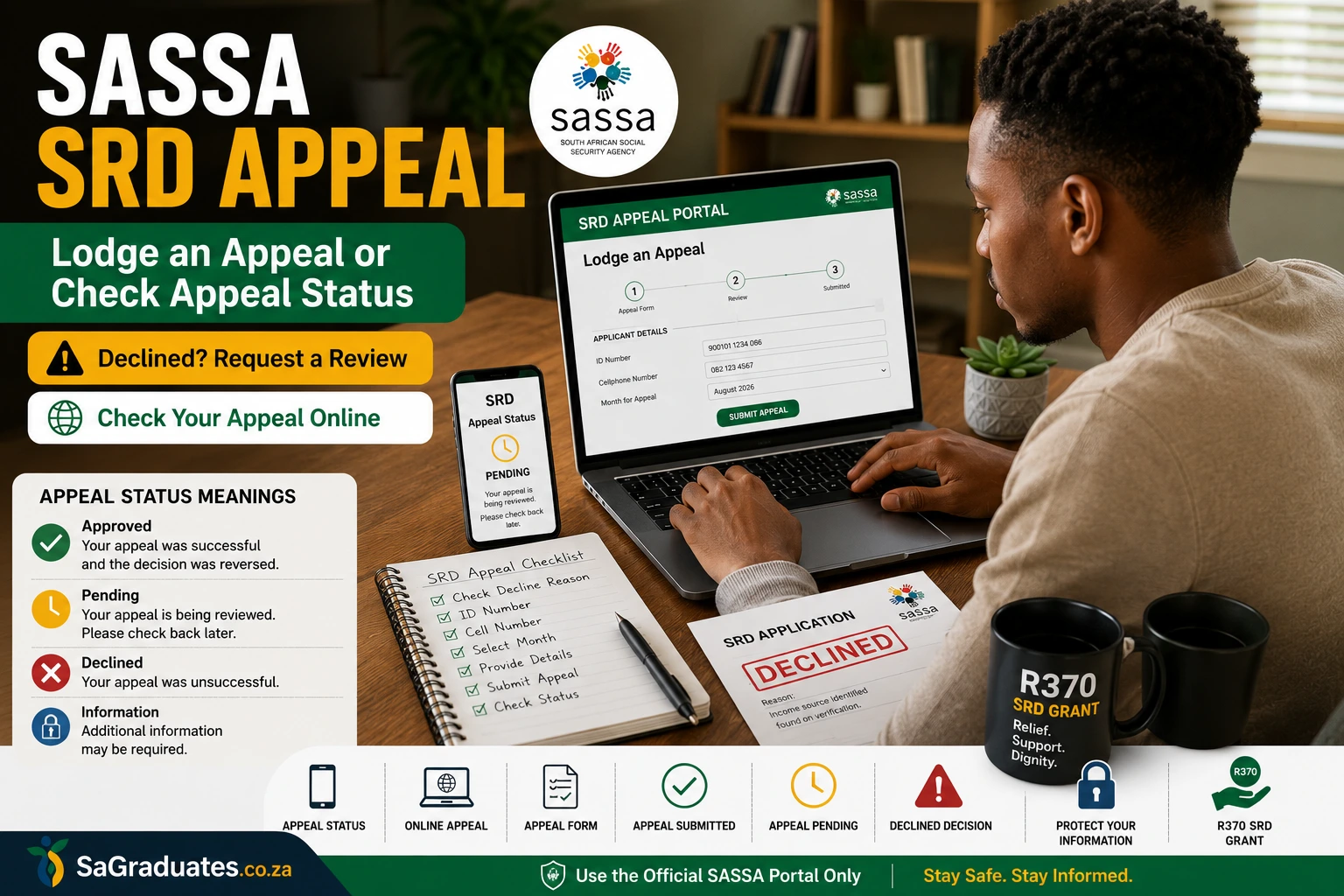
Need a SASSA SRD appeal? Learn how to challenge a declined R370 grant, check your appeal status, understand the decline reason and follow the official process.
If your SASSA SRD appeal has been declined and you believe the decision was incorrect, you have a formal process available to challenge the outcome. For applicants who have already submitted an appeal, checking the appeal status is equally important because the outcome can determine whether the original decision is overturned.
The Social Relief of Distress (SRD) grant is administered by the South African Social Security Agency (SASSA). The official SRD portal states that when an application is declined, the applicant has the right to appeal the decision with the Department of Social Development for each month in which the application was declined.
This monthly approach is important. An applicant should not assume that one successful appeal automatically changes the outcome for every month. Each declined period needs to be considered separately.
The appeal process is also different from simply submitting a new SRD application. An appeal challenges a specific decision and asks for that decision to be reviewed.
For applicants trying to resolve an unsuccessful SRD application, understanding why the application was declined, how to lodge an appeal, how to check an appeal status and what happens after submission can make the process considerably easier to navigate.
Also Apply here How to Apply for the SASSA SRD Grant in 2026: 7 Steps to Get Your R370 Application Right
Quick Facts: SASSA SRD Appeal
| Detail | Information |
|---|---|
| Programme | Social Relief of Distress (SRD) Grant |
| Organisation | South African Social Security Agency (SASSA) |
| Appeal authority | Department of Social Development / Independent Tribunal for Social Assistance Appeals |
| Location | South Africa |
| Grant amount | R370 |
| Closing date | Not stated in the official information |
| Duration | SRD provision extended to 31 March 2027 |
| Positions available | Not applicable |
| Reference number | Not stated in the official information |
| Stipend | Not applicable |
| Required gender | Not stated in the official information |
| Enquiries | SASSA Call Centre: 0800 60 10 11 |
| How to apply/appeal | Online through the official SRD/DSD appeals process |
The Department of Social Development’s 2026 “You and Your Grant” information identifies srd.dsd.gov.za as the direct appeals channel for COVID-19 SRD matters.
Why the SASSA SRD Appeal Process Matters
A declined SRD application can have a significant effect on someone who depends on the grant for basic expenses. However, the word “declined” does not necessarily mean that the applicant has no further recourse.
The official SASSA SRD portal specifically states that a person whose application is declined has the right to appeal the SASSA decision.
The important question is therefore not simply whether an application was declined, but why it was declined.
SASSA’s verification process considers information supplied by applicants and information obtained through relevant verification systems. The official SRD portal explains that applicants provide personal details, employment and lifestyle sustainability information, banking information and a cellphone number.
This means that a decline can result from information that the applicant believes is inaccurate, outdated or incorrectly associated with them.
For example, SASSA has explained that an SRD application can be declined where its systems identify a source of income. Applicants who believe that this finding is incorrect have a right to appeal.
The appeal mechanism therefore provides an opportunity for an applicant to dispute an assessment rather than simply accepting the original outcome.
1. When Should You Lodge a SASSA SRD Appeal?
The first step is to establish whether you actually have a reason to appeal.
An appeal is appropriate when your SRD application was declined and you believe the reason for the decline does not accurately reflect your circumstances.
The official SASSA SRD portal confirms that declined applicants can appeal and that the appeal should be lodged for each month in which the application was declined.
This monthly structure is one of the most important points applicants need to understand.
Suppose an applicant was declined for June, July and August. A successful appeal for June should not automatically be interpreted as an appeal for July and August.
Each month has its own assessment.
This is because SRD eligibility is assessed periodically and an applicant’s circumstances can change from one month to another.
The applicant should therefore identify the exact month shown as declined before beginning the appeal process.
Another important point is that an appeal should address the actual reason for the decline.
For example, if the system identifies income that the applicant says they did not receive, the appeal should challenge that specific finding.
Simply stating that the grant is needed financially does not necessarily address the reason for the original decision.
A more effective approach is to understand the assessment and explain why the decision should be reconsidered.
2. How to Lodge a SASSA SRD Appeal Online
The current official information identifies the SRD appeals platform as the online route for appealing a declined SRD decision.
The Department of Social Development’s 2026 grant booklet specifically lists srd.dsd.gov.za as the direct appeals channel for COVID-19 SRD matters.
The SASSA SRD portal also directs declined applicants to lodge an appeal with the Department of Social Development.
Applicants should therefore start from the official SASSA SRD website or the official Department of Social Development appeals platform rather than using third-party websites.
The general process involves:
- Accessing the official SRD appeals platform.
- Providing the identification and cellphone details requested by the system.
- Completing the required verification.
- Selecting the specific declined month.
- Reviewing the reason for the decline.
- Following the instructions to lodge the appeal.
- Submitting the appeal for consideration.
- Keeping the relevant confirmation or reference information.
- Checking the appeal status after submission.
Applicants should make sure that the information associated with their SRD application is accurate.
The official SASSA portal stresses the importance of providing a cellphone number through which SASSA can communicate with the applicant. It also states that applicants should contact the call centre if the number needs to be updated.
This makes access to the registered cellphone number particularly important during online processes.
3. SASSA SRD Appeal: Why the Decline Reason Matters
One of the most useful ways to approach an appeal is to treat the decline reason as the starting point rather than an obstacle.
SASSA’s verification systems can identify circumstances that affect eligibility.
A 2026 SASSA statement, for example, explains that a grant may be declined when the system discovers a source of income through external databases, including financial institutions. The same statement confirms that a declined beneficiary who is dissatisfied with the reason has a right to appeal.
This illustrates why applicants should first read the exact reason displayed on their status.
Possible issues can involve matters such as:
- Income being identified.
- Identity verification problems.
- Other government assistance.
- UIF-related information.
- Information that does not match government records.
- Other eligibility or verification findings.
Historical Department of Social Development material also shows that SRD decisions have been based on monthly verification and that applicants could request reconsideration where they believed a decline reason was invalid.
However, applicants should be careful about relying on old thresholds or outdated rules when preparing a current appeal. SRD regulations and eligibility conditions have changed over time.
The safest approach is to focus on the current reason shown on the official application or appeal system.
For example, if the system identifies income that the applicant believes is not their income, the applicant should address that particular issue rather than submitting a generic appeal.
This makes the appeal more focused and easier to understand.
4. How to Check Your SASSA SRD Appeal Status
After an appeal has been lodged, applicants naturally want to know whether it has been processed.
The official appeals process is designed to allow applicants to follow the outcome of their appeal.
Applicants should use the official SRD appeals platform to check the status of an appeal rather than relying on third-party websites claiming to provide private or faster access to SASSA information.
The basic approach is to:
- Open the official SRD appeals platform.
- Enter the requested identification details.
- Enter or verify the cellphone number associated with the application.
- Complete any OTP or security verification requested.
- Select the relevant appealed month.
- Review the latest appeal outcome displayed.
The month being checked is important.
An applicant may have appealed more than one declined month, and the outcome of one month should not automatically be assumed to apply to another.
The official SASSA information specifically says that applicants must lodge an appeal for each month their application was declined.
This means that applicants should keep track of which months they appealed and monitor those periods individually.
If the online process does not work, applicants can contact SASSA for assistance. The official 2026 SASSA grant booklet lists the SASSA call centre as 0800 60 10 11 and also provides other official communication channels.
5. What Happens After a SASSA SRD Appeal?
An appeal is essentially a request for the original decision to be reviewed.
Applicants should therefore understand that submitting an appeal does not mean that approval is automatic.
The appeal must be assessed against the applicable eligibility and verification information.
The Department of Social Development has previously explained that SRD appeals are handled through the appeals structure rather than simply being treated as a new application.
This distinction is important because an appeal is not an opportunity to ignore the original eligibility requirements.
Instead, the applicant is saying that the decision made for that particular period was incorrect and should be reconsidered.
The possible outcome will depend on the review.
If the appeal is successful, the original decline can be overturned for the relevant month.
If the appeal is unsuccessful, the original decision remains in place for that period.
Applicants should therefore continue checking the official portal for the outcome rather than assuming that silence means approval.
It is also important to keep the cellphone number associated with the application active where possible because SASSA uses applicant contact details to communicate information relating to applications.
6. Avoiding Scams When Lodging or Checking an SRD Appeal
Because SRD applicants are often financially vulnerable, scammers may attempt to exploit people looking for information about appeals or payments.
SASSA has specifically warned beneficiaries to protect their personal information and verify anyone claiming to represent the agency.
The 2026 SASSA grant booklet also warns beneficiaries never to share their bank PIN and states that SASSA will never request a PIN during an interaction.
This is particularly relevant when checking an appeal online.
Applicants should be suspicious of anyone who:
- Promises guaranteed SRD approval.
- Requests payment to lodge an appeal.
- Requests a bank PIN.
- Asks for sensitive banking information unnecessarily.
- Claims they can speed up an appeal for a fee.
- Sends suspicious links through social media.
- Requests an OTP without a legitimate reason.
The official process should always be the first choice.
SASSA’s 2026 service information lists the official SRD portal, SASSA website, call centre, WhatsApp chatbot and email support among its service channels.
Using those channels reduces the risk of handing personal information to an unofficial intermediary.
What You Need Before Lodging an SRD Appeal
Applicants should prepare before starting the process.
At minimum, they should have access to the information connected to their SRD application.
This includes:
- Your South African ID or relevant identification information.
- The cellphone number linked to your application.
- The declined month you want to appeal.
- The decline reason shown on the official system.
- Any relevant information needed to explain why you believe the decision is incorrect.
The official SRD portal confirms that applicants provide personal details, cellphone information, employment and lifestyle sustainability information and banking information as part of the SRD process.
Applicants should also avoid changing information unnecessarily simply because an application has been declined.
A change should reflect a genuine change in circumstances or correct inaccurate information.
SASSA has previously warned that repeated changes to banking information can contribute to delays in processing.
Requirements-SASSA SRD Appeal
The SRD programme is intended for qualifying applicants who meet the applicable eligibility conditions. The official SASSA SRD portal states that the grant is aimed at South African citizens, refugees, asylum seekers and certain special permit holders aged 18 to 60 who have insufficient means and meet the other applicable requirements.
For an appeal, the key requirement is that the applicant has a declined SRD application and believes the decision should be reviewed.
Duties
The SRD is a social assistance programme and not an employment opportunity.
Enquiries
SASSA Call Centre: 0800 60 10 11.
Applicants can also use the official SASSA service channels for assistance.
Closing Date
The SRD provision has been extended through 31 March 2027, but applicants should check the official appeals platform for the applicable appeal period for their specific declined month.
Company Name
South African Social Security Agency (SASSA).
SRD appeals are handled through the Department of Social Development’s appeals structure.
How to Apply or Lodge an Appeal for SASSA SRD Appeal
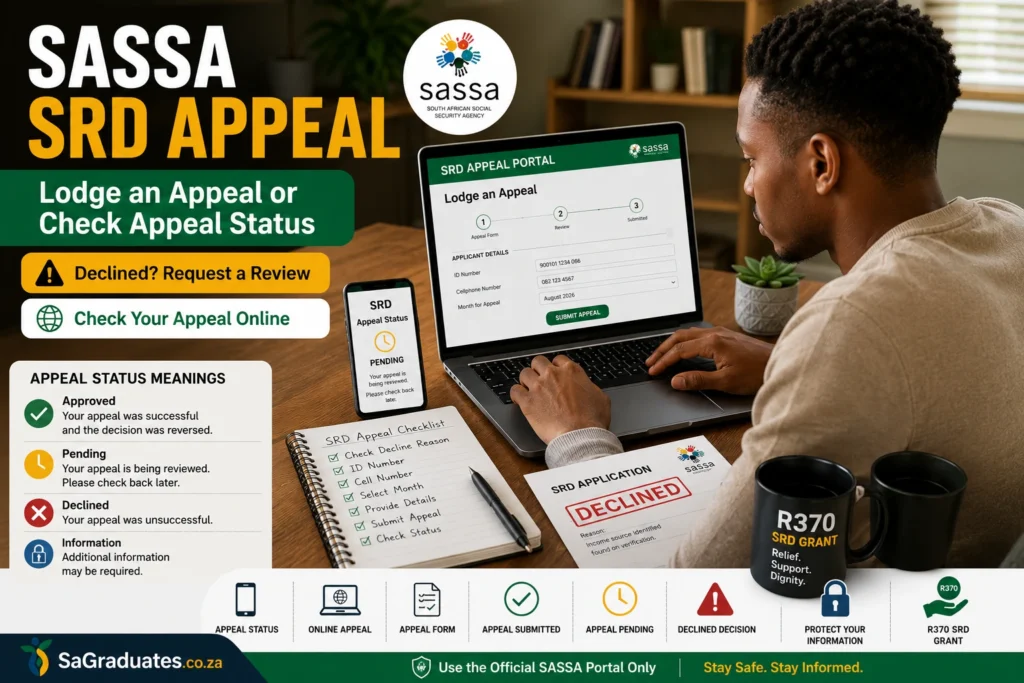
If your SRD application has been declined and you believe the decision is incorrect:
- Access the official SASSA SRD platform.
- Follow the link to the SRD appeal process.
- Use the identification and cellphone information connected to your application.
- Complete the required verification.
- Select the declined month.
- Review the decline reason.
- Follow the instructions to submit your appeal.
- Keep your confirmation details.
- Return to the official appeals platform to check the outcome.
The Department of Social Development’s current 2026 grant information identifies srd.dsd.gov.za as the direct appeals channel for COVID-19 SRD matters.
Official SRD portal: SASSA SRD official website
Official SRD appeals platform: Department of Social Development SRD appeals portal
Frequently Asked Questions-SASSA SRD Appeal
1. Can I appeal if my SASSA SRD application was declined?
Yes. The official SASSA SRD portal confirms that a declined applicant has the right to appeal the decision. An appeal must be lodged for each month in which the application was declined.
2. Do I need to appeal every declined month separately?
Yes. SASSA’s official information specifically states that applicants must lodge an appeal for each month their application was declined.
3. How can I check my SRD appeal status?
Use the official SRD appeals platform and follow the verification process to view the status or outcome associated with the relevant appealed month. If you experience difficulties, contact SASSA on 0800 60 10 11.
Final Thought-SASSA SRD Appeal
A declined SRD application does not necessarily mean the process has ended. If you believe the decision was based on incorrect or outdated information, the official SASSA SRD appeal process provides a way to request that the decision be reviewed.
The most important step is to understand the reason for the decline before submitting an appeal. An appeal should be connected to the specific decision being challenged, and applicants should remember that each declined month is treated separately.
For people who have already lodged an appeal, checking the appeal status is equally important. The online system provides a way to follow the progress of the appeal, while SASSA’s call centre can provide assistance where applicants experience problems accessing services.
Applicants should also be particularly careful with their personal information. SASSA has warned about scams targeting vulnerable beneficiaries, and official guidance makes clear that beneficiaries should never share their bank PIN with anyone claiming to represent SASSA.
Ultimately, the safest approach is simple: use official SASSA and Department of Social Development channels, appeal the specific month that was declined, understand the reason behind the decision and monitor the official appeal outcome.






Leave a Reply