

Are learnerships worth it in 2026? Explore the real pros and cons of South African learnership programmes, including employment opportunities, stipends, skills development and long-term career impact.
Are learnerships worth it in 2026? Pros and Cons
South Africa’s youth unemployment crisis continues to place enormous pressure on young people trying to enter the workforce. For many matriculants, TVET graduates and unemployed youth, learnerships have become one of the few accessible pathways into professional experience, accredited training and potential employment. Yet despite their popularity, an important question remains: are learnerships actually worth it?
The debate around learnerships has intensified in 2026 as more companies expand workplace training programmes while thousands of applicants compete for limited opportunities. Some participants describe learnerships as life-changing stepping stones into stable employment. Others argue that certain programmes offer temporary experience without guaranteeing long-term jobs.
Understanding the true value of learnerships requires more than simple encouragement or criticism. Their effectiveness depends on industry demand, programme quality, employer commitment and the learner’s long-term goals. For many South Africans, learnerships sit at the intersection of education, employment policy and economic survival.
This article explores the advantages, limitations and long-term implications of learnerships in South Africa, while analysing whether these programmes genuinely improve employability in an increasingly competitive labour market.
ALSO READ How Learnership Programmes Help South African Employers Build Skills and Reduce Hiring Costs 2026
ALSO APPLY FOR TotalEnergies Supply Chain Learnership 2026 Opens Valuable Operations Training Opportunity for Young South Africans
Quick Facts Box About Are learnerships worth it in 2026?
| Information | Details |
|---|---|
| Closing Date | Not stated in the official advert |
| Location | South Africa |
| Duration | Varies by programme |
| Positions Available | Not stated in the official advert |
| Reference Number | Not stated in the official advert |
| Stipend | Depends on employer and programme |
| Required Gender | Not stated in the official advert |
| Name of the Company | Various employers and SETA-accredited organisations |
Understanding How Learnerships Work in South Africa-Are learnerships worth it in 2026?
A learnership is a structured workplace training programme that combines theoretical learning with practical job experience. These programmes are usually registered with Sector Education and Training Authorities (SETAs) and often lead to a nationally recognised qualification on the National Qualifications Framework (NQF).
Unlike traditional academic study, learnerships are designed to expose participants directly to workplace environments. Learners may spend part of their time attending training sessions and the remainder performing practical duties under supervision.
The rise of learnerships in South Africa is closely linked to broader economic and educational challenges. Employers frequently report that graduates lack practical workplace readiness, while young job seekers struggle to obtain experience because employers prefer experienced candidates. Learnerships attempt to close this gap by creating entry-level exposure opportunities.
Industries such as banking, telecommunications, logistics, mining, retail, information technology and healthcare increasingly rely on learnership models to develop future talent pipelines. In many sectors, learnerships are no longer viewed purely as social responsibility initiatives but as workforce development strategies.
However, the quality and outcomes of programmes differ significantly between organisations. This inconsistency partly explains why opinions about learnerships remain divided.
The Biggest Advantage: Workplace Experience-Are learnerships worth it in 2026?

One of the strongest arguments in favour of learnerships is their ability to provide practical work experience. In South Africa’s labour market, experience often matters as much as formal qualifications.
Many unemployed graduates discover that academic certificates alone do not automatically lead to employment. Employers increasingly prioritise candidates who understand workplace systems, communication standards, deadlines and organisational culture. Learnerships expose participants to these realities early.
This practical exposure offers several advantages: Are learnerships worth it in 2026?
- Learners gain familiarity with professional environments.
- They build confidence interacting with supervisors and colleagues.
- They develop technical and administrative skills.
- They gain experience using workplace software and systems.
- They improve time management and communication abilities.
For first-time job seekers, even six to twelve months of workplace exposure can strengthen a CV considerably. Candidates who complete recognised learnership programmes often appear more employable than applicants with no practical experience.
This is particularly true in sectors such as customer service, administration, call centres, banking operations and technical support, where employers value operational readiness.
Another overlooked benefit is networking. Learnership participants interact directly with managers, trainers and professionals who may later provide references or employment opportunities. In a highly competitive job market, these professional connections can become extremely valuable.
The Financial Reality: Stipends Are Helpful but Often Limited-Are learnerships worth it in 2026?
One reason many South Africans apply for learnerships is the financial support provided through monthly stipends. For unemployed youth with limited income opportunities, even modest stipends can help cover transport, food and household expenses.
However, expectations around learnership stipends often create confusion.
Learnerships are not full employment contracts. In most cases, stipends are designed to support participation rather than provide sustainable salaries. Some programmes offer relatively competitive monthly payments, while others provide only minimal financial assistance.
The value of a stipend also depends heavily on location. Participants in major cities such as Johannesburg, Cape Town and Durban may find that transport and living costs consume most of their monthly allowance.
This financial limitation creates an important challenge. Some learners complete programmes successfully but still struggle economically during the training period. Others leave programmes early because the stipend cannot adequately support their needs.
Another concern involves delayed payments. Complaints occasionally emerge regarding administrative delays between training providers, employers and SETAs. When payments are disrupted, financially vulnerable learners are affected most severely.
Despite these concerns, learnerships still remain financially preferable to unpaid internships or long-term unemployment for many participants.
Do Learnerships Actually Lead to Permanent Jobs?
This is arguably the most important question surrounding learnerships in 2026.
The honest answer is complicated.
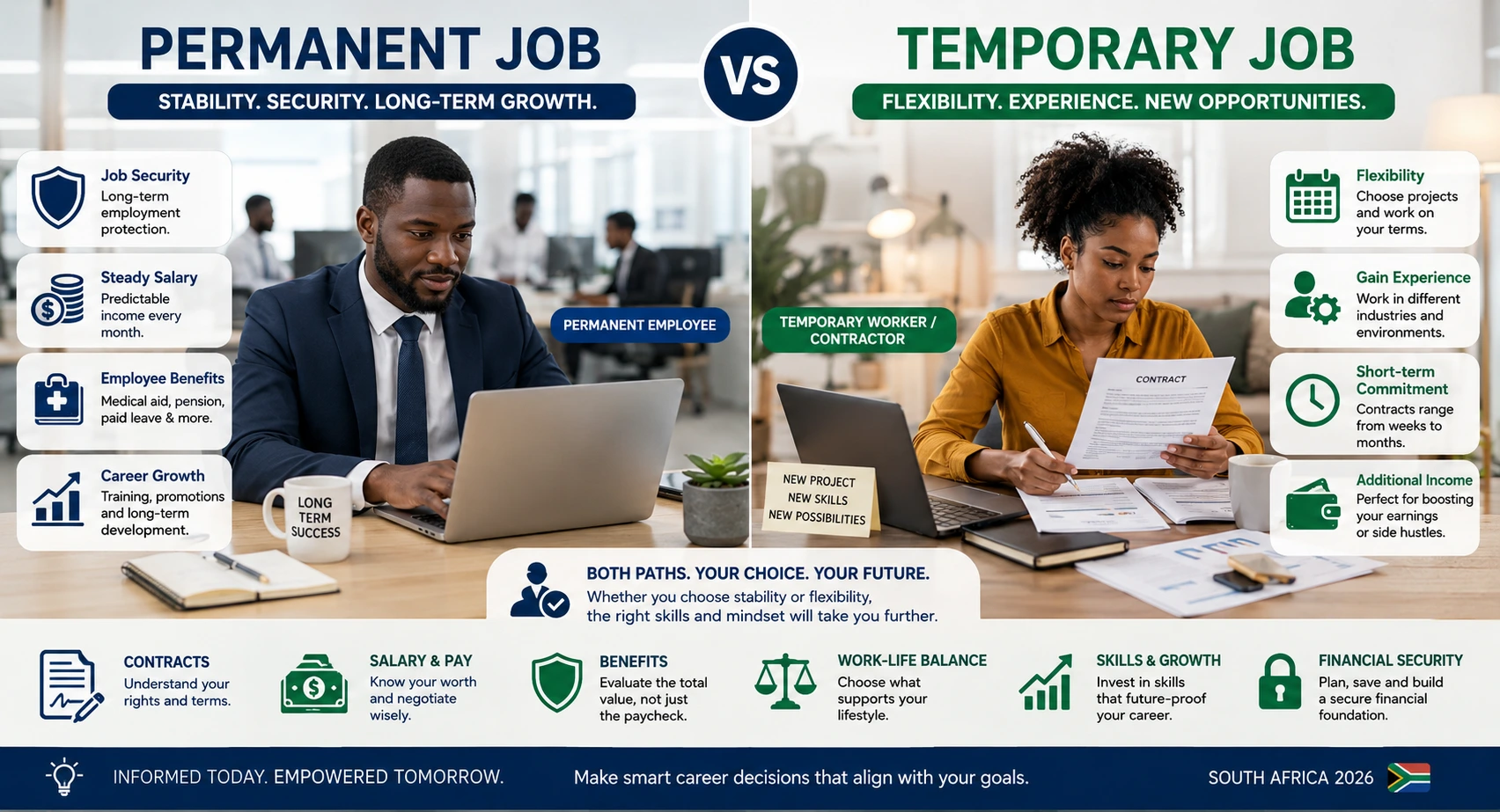
Some learnerships directly lead to permanent employment opportunities, especially when companies use programmes to identify future staff members. Employers sometimes absorb high-performing learners into junior positions after programme completion.
Industries facing skills shortages — including information technology, engineering support, digital services and specialised administration — are more likely to convert learners into permanent employees.
However, there is no universal guarantee of employment after completion.
In many cases, companies hire learners only for the programme duration because of operational budgets, labour structures or B-BBEE skills development targets. Once the programme ends, participants may receive certificates but no permanent placement.
This has led to criticism from some young South Africans who feel trapped in cycles of temporary programmes without long-term career stability.
Nevertheless, even where direct employment is unavailable, completed learnerships may still improve future job prospects. Employers often favour candidates with recognised workplace exposure over applicants with no practical training.
The key issue is employability versus guaranteed employment. Learnerships improve employability, but they do not automatically guarantee jobs.
Understanding this distinction is essential for realistic expectations.
Why Some Learnerships Deliver Better Outcomes Than Others-Are learnerships worth it in 2026?
Not all learnerships provide equal value. Programme quality varies significantly depending on the employer, industry and training provider involved.
High-quality learnerships usually share several characteristics: Are learnerships worth it in 2026?
- Structured mentorship and supervision
- Relevant workplace responsibilities
- Accredited qualifications
- Clear learning outcomes
- Exposure to real operational systems
- Strong employer reputation
- Opportunities for career progression
In contrast, weaker programmes may offer limited practical training or assign learners repetitive tasks with little meaningful development.
The reputation of the employer also matters. Learnership experience gained at recognised companies often carries stronger credibility during future job applications.
Another major factor is industry alignment. Learnerships connected to growing sectors generally provide stronger long-term value than those linked to shrinking or oversaturated industries.
For example, programmes focused on digital skills, cybersecurity, logistics technology, renewable energy support, financial services and data administration are increasingly aligned with future labour market demand.
Meanwhile, sectors experiencing automation or declining hiring activity may offer fewer long-term opportunities despite providing valuable short-term exposure.
Learners who strategically select programmes connected to expanding industries usually gain stronger career advantages over time.
The Psychological and Professional Benefits Often Overlooked-Are learnerships worth it in 2026?
Public discussions about learnerships frequently focus only on money or employment outcomes. Yet many participants experience significant personal and professional growth beyond these measurable factors.
Long-term unemployment can negatively affect confidence, motivation and mental resilience. Learnership participation often restores routine, structure and professional identity.
Participants learn workplace etiquette, communication standards and problem-solving approaches that formal education sometimes fails to teach effectively.
For many young South Africans, learnerships also provide their first exposure to: Are learnerships worth it in 2026?
- Corporate culture
- Professional accountability
- Team collaboration
- Digital workplace systems
- Customer engagement
- Performance evaluations
These experiences shape future behaviour in ways that extend beyond the programme itself.
Employers frequently mention attitude, professionalism and adaptability as important hiring considerations. Learnerships help participants develop these soft skills in real-world environments.
Even when programmes do not lead directly to employment, the psychological impact of gaining workplace exposure can improve future confidence during interviews and job applications.
The Criticism: Are Some Employers Exploiting the System?
Despite their benefits, learnerships are not free from criticism.
Labour activists and some former participants argue that certain organisations misuse learnership programmes as sources of low-cost temporary labour. Critics claim some companies repeatedly recruit learners without creating genuine long-term employment pathways.
Concerns also exist around: Are learnerships worth it in 2026?
- Poor supervision
- Administrative inefficiency
- Delayed certification
- Limited practical exposure
- Inadequate mentorship
- Overcrowded recruitment systems
Another issue involves unrealistic public expectations. Social media sometimes portrays learnerships as guaranteed employment opportunities, leading applicants to assume permanent jobs are certain.
This mismatch between expectation and reality can cause disappointment.
Additionally, competition for reputable programmes has become extremely intense. Large employers may receive tens of thousands of applications for limited intake positions. This reflects both the popularity of learnerships and the severity of South Africa’s unemployment challenge.
While criticism is valid in some cases, it is important to separate poorly managed programmes from the broader concept itself. Effective learnerships still provide meaningful value when properly structured and aligned with labour market needs.
What This Means Going Forward-Are learnerships worth it in 2026?
The future of learnerships in South Africa will likely become even more important as economic pressures, automation and skills shortages continue reshaping the labour market.
Several trends are already emerging in 2026: Are learnerships worth it in 2026?
Digital Skills Will Dominate-Are learnerships worth it in 2026?
Programmes connected to technology, cybersecurity, data analysis, cloud systems and digital operations are expanding rapidly. Employers increasingly seek adaptable workers with both technical and practical skills.
Employers Want Workplace-Ready Candidates-Are learnerships worth it in 2026?
Companies continue prioritising applicants who require less onboarding and operational adjustment. Learnerships directly address this need by providing practical exposure before permanent hiring.
Competition Will Increase-Are learnerships worth it in 2026?
As youth unemployment remains high, competition for reputable learnership opportunities will intensify. Applicants with stronger CVs, digital literacy and communication skills may gain advantages during recruitment.
Skills-Based Hiring Is Growing-Are learnerships worth it in 2026?
Globally and locally, employers are gradually placing more emphasis on demonstrable skills rather than qualifications alone. Learnerships align closely with this shift because they combine practical and theoretical development.
Programme Quality Will Matter More-Are learnerships worth it in 2026?
Learners may become increasingly selective about employers, accreditation status and career outcomes. Reputation and industry relevance will likely become key decision-making factors.
Ultimately, learnerships are evolving beyond basic workplace exposure programmes. They are becoming strategic entry points into South Africa’s changing employment ecosystem.
FAQs-Are learnerships worth it in 2026?
Are learnerships better than internships?
Not always. Learnerships usually include accredited training and structured qualifications, while internships focus mainly on workplace experience. The better option depends on career goals and industry requirements.
Can you get a permanent job after a learnership?
Yes, some employers hire successful learners permanently. However, employment is not guaranteed and depends on company needs, performance and available vacancies.
Conclusion-Are learnerships worth it in 2026?
Learnerships remain one of the most practical entry-level opportunities available to unemployed South Africans seeking workplace exposure, accredited training and improved employability. While they are not guaranteed pathways to permanent employment, they often provide valuable experience that strengthens future job prospects.
The true value of a learnership depends heavily on programme quality, industry relevance and the learner’s long-term strategy. High-quality programmes can open meaningful career pathways, build confidence and create professional networks that extend far beyond the training period itself.
At the same time, applicants should approach learnerships with realistic expectations. These programmes are best viewed as stepping stones rather than automatic employment solutions.
In a labour market where practical skills increasingly matter, learnerships continue playing an important role in bridging the gap between education and employment for thousands of South Africans.









Leave a Reply