
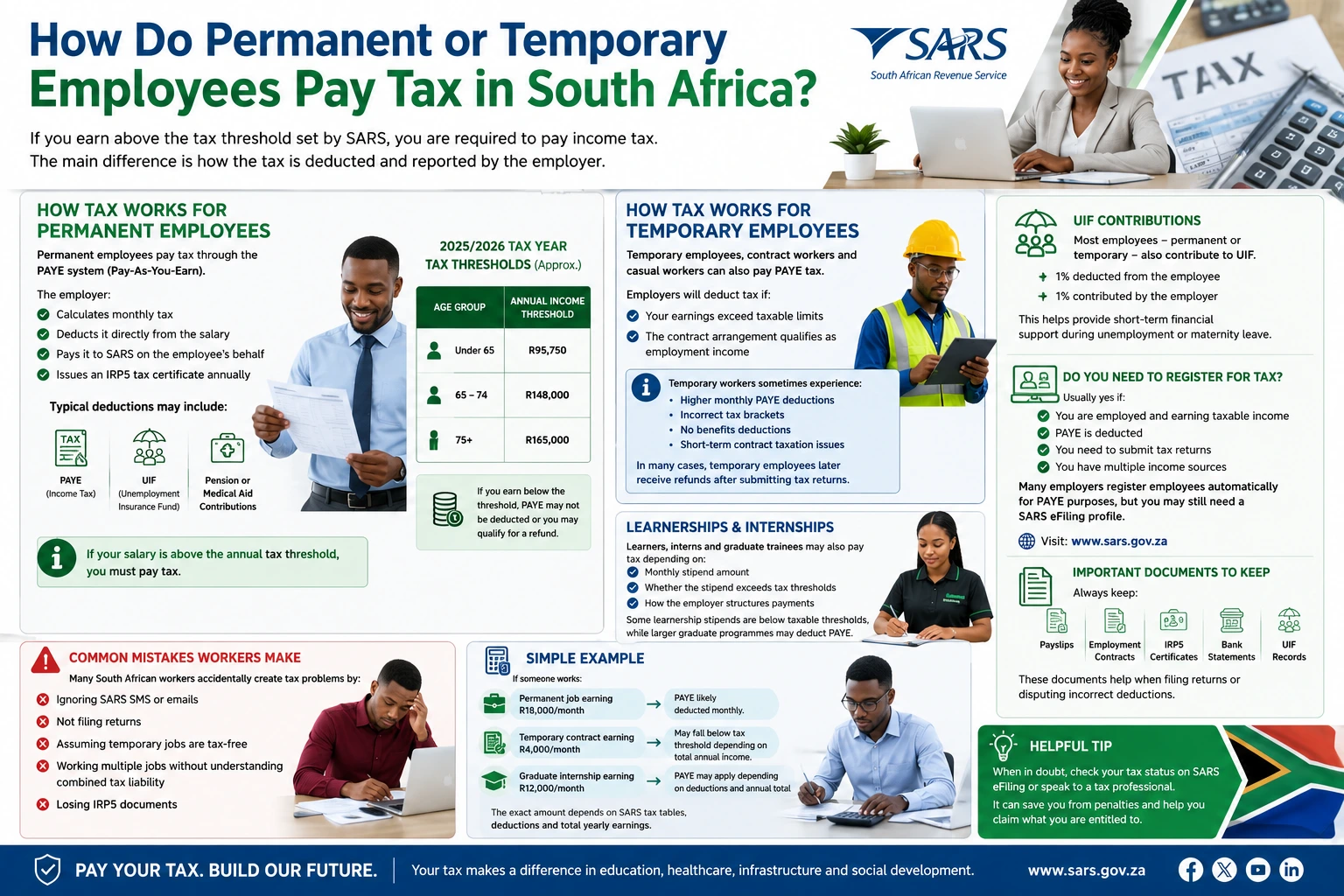
In South Africa, both permanent and temporary employees are generally required to pay income tax if they earn above the tax threshold set by the South African Revenue Service (SARS). The main difference is usually how the tax is deducted and reported by the employer.How Tax Works in South Africa.
How Tax Works for Permanent Employees-How Tax Works in South Africa
Permanent employees normally pay tax through the PAYE system (Pay-As-You-Earn).
The employer: How Tax Works in South Africa
- Calculates monthly tax
- Deducts it directly from the salary
- Pays it to SARS on the employee’s behalf
- Issues an IRP5 tax certificate annually
Typical deductions may include: How Tax Works in South Africa
- PAYE (income tax)
- UIF (Unemployment Insurance Fund)
- Sometimes pension or medical aid contributions
If your salary is above the annual tax threshold, you must pay tax.
For the 2025/2026 tax year, the approximate tax thresholds are: How Tax Works in South Africa
| Age Group | Annual Income Threshold |
|---|---|
| Under 65 | Around R95,750 |
| 65–74 | Around R148,000 |
| 75+ | Around R165,000 |
If you earn below the threshold, PAYE may not be deducted or you may qualify for a refund.
How Tax Works for Temporary Employees-How Tax Works in South Africa
Temporary employees, contract workers and casual workers can also pay PAYE tax.
Employers still deduct tax if: How Tax Works in South Africa
- Your earnings exceed taxable limits
- The contract arrangement qualifies as employment income
However, temporary workers sometimes experience: How Tax Works in South Africa
- Higher monthly PAYE deductions
- Incorrect tax brackets
- No benefits deductions
- Short-term contract taxation issues
This happens because SARS may tax temporary earnings at estimated annual rates if payroll systems assume the income will continue for a full year.
In many cases, temporary employees later receive refunds after submitting tax returns.
Learnerships and Internships-How Tax Works in South Africa
Learners, interns and graduate trainees may also pay tax depending on: How Tax Works in South Africa
- Monthly stipend amount
- Whether the stipend exceeds tax thresholds
- How the employer structures payments
Some learnership stipends are below taxable thresholds, while larger graduate programmes may deduct PAYE normally.
UIF Contributions-How Tax Works in South Africa
Most employees — permanent or temporary — also contribute to UIF.
UIF is usually: How Tax Works in South Africa
- 1% deducted from the employee
- 1% contributed by the employer
This helps provide short-term financial support during unemployment or maternity leave.
Do You Need to Register for Tax?
Usually yes if: How Tax Works in South Africa
- You are employed and earning taxable income
- PAYE is deducted
- You need to submit tax returns
- You have multiple income sources
Many employers register employees automatically for PAYE purposes, but you may still need a SARS eFiling profile.
You can access SARS services through: How Tax Works in South Africa
SARS Official Website
Important Things Employees Should Keep
Always keep: How Tax Works in South Africa
- Payslips
- Employment contracts
- IRP5 certificates
- Banking records
- UIF records
These documents help when filing returns or disputing incorrect deductions.
ALSO READ Top Industries Offering Learnerships in South Africa: Where the Real Opportunities Are in 2026
Common Mistakes Workers Make
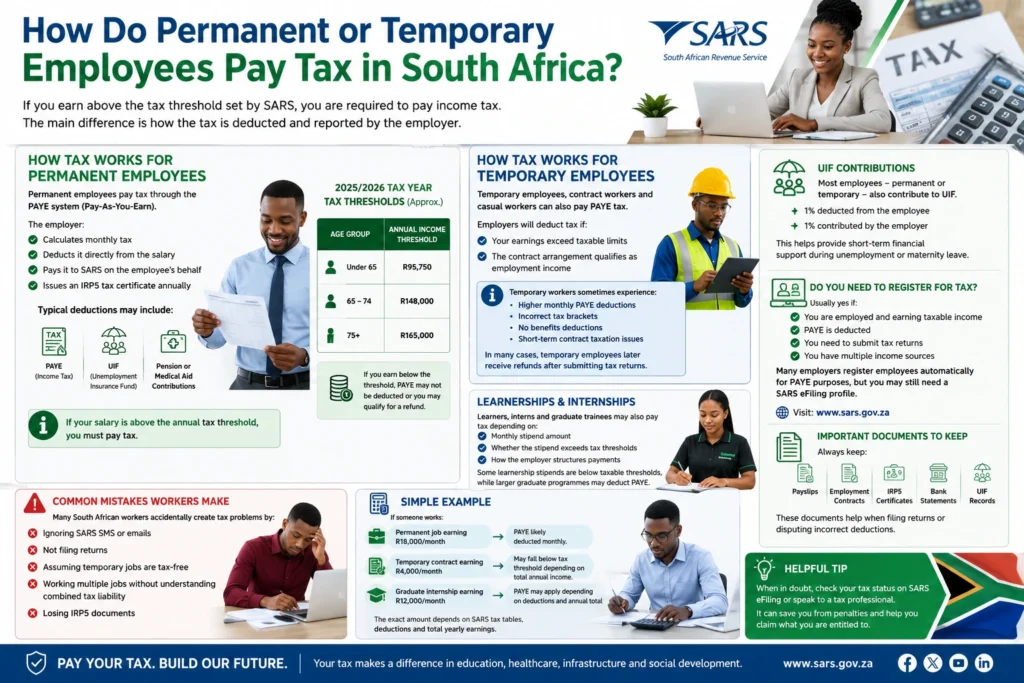
Many South African workers accidentally create tax problems by:
- Ignoring SARS SMS or emails
- Not filing returns
- Assuming temporary jobs are tax-free
- Working multiple jobs without understanding combined tax liability
- Losing IRP5 documents
Even temporary or part-time income can sometimes become taxable once combined annually.
Simple Example
If someone works: How Tax Works in South Africa
- Permanent job earning R18,000/month → PAYE likely deducted monthly.
- Temporary contract earning R4,000/month → may fall below tax threshold depending on total annual income.
- Graduate internship earning R12,000/month → PAYE may apply depending on deductions and annual total.
The exact amount depends on SARS tax tables, deductions and total yearly earnings.
Additional Tax Information in South Africa You Can Add to Your Article
Why Many Young Workers Get Confused About PAYE-How Tax Works in South Africa
One of the biggest reasons new employees struggle with tax in South Africa is because PAYE deductions often begin before workers fully understand how the system operates. Many first-time employees only notice that their salary is lower than expected after deductions appear on their payslip.
This confusion is especially common among:
- Learnership participants
- Graduate interns
- Temporary workers
- Part-time employees
- Contract workers
In many cases, workers incorrectly assume the employer is “taking too much money,” when the deductions are actually standard SARS payroll requirements.
Understanding payslip deductions early can help employees avoid financial misunderstandings later.
What PAYE Actually Covers
PAYE stands for “Pay-As-You-Earn,” which means income tax is deducted before the employee receives their salary.
Employers deduct PAYE on behalf of the South African Revenue Service and submit it monthly.
PAYE helps fund:
- Public healthcare
- Roads and infrastructure
- Education
- Social grants
- Government services
For employees, PAYE reduces the risk of owing large tax amounts at the end of the financial year because payments are spread across monthly earnings.
Why Some Workers Receive Tax Refunds
Many South Africans are surprised when SARS pays refunds into their bank accounts after tax season.
Refunds usually happen when:
- Too much PAYE was deducted
- Workers changed jobs during the year
- Temporary contracts ended early
- Employers applied incorrect tax rates
- Medical aid or retirement deductions qualify for rebates
Temporary workers and interns often receive refunds because payroll systems sometimes estimate annual earnings incorrectly.
However, refunds are not guaranteed. Some taxpayers may still owe SARS money depending on their total annual income and deductions.
Understanding IRP5 Documents
An IRP5 is one of the most important tax documents for employees in South Africa.
The IRP5 shows:
- Total income earned
- PAYE deducted
- UIF contributions
- Tax reference information
- Employment periods
Employees usually receive this document from employers during tax season.
Without an IRP5, it becomes difficult to file accurate tax returns.
Workers should always keep digital and printed copies safely stored.
Why UIF Is Important for Employees
Many workers focus only on PAYE deductions but underestimate the importance of UIF contributions.
The Unemployment Insurance Fund helps provide short-term financial relief when workers experience:
- Job loss
- Maternity leave
- Illness leave
- Reduced working hours
Both employers and employees contribute toward UIF monthly.
Even temporary employees may qualify for UIF benefits if contributions were correctly processed.
Tax Problems That Commonly Affect Young South Africans
First-time workers often make avoidable tax mistakes because they lack financial education.
Common problems include:
- Ignoring SARS communication
- Not updating banking details
- Failing to register on eFiling
- Losing passwords and tax reference numbers
- Believing small side jobs are automatically tax-free
The rise of freelance work, side hustles and digital income streams has also increased tax complexity for younger workers.
Income from online work, tutoring, content creation or delivery platforms may still need to be declared depending on annual earnings.
The Growing Importance of Financial Literacy
Financial literacy is becoming increasingly important in South Africa’s changing employment environment.
Understanding tax basics can help workers: How Tax Works in South Africa
- Avoid penalties
- Budget properly
- Track deductions
- Claim legitimate refunds
- Build stronger financial habits
Many experts believe tax education should become part of workplace onboarding programmes, especially for youth entering employment for the first time.
As more South Africans enter learnerships, internships and short-term contracts, understanding tax obligations may become just as important as understanding employment contracts themselves.
Suggested Additional FAQ-How Tax Works in South Africa
Do temporary workers pay tax in South Africa?
Yes. Temporary workers may still pay PAYE tax if their income exceeds SARS thresholds or if employers deduct tax through payroll systems.
Can SARS refund excess tax deductions?
Yes. If too much PAYE was deducted during the tax year, eligible taxpayers may receive refunds after submitting tax returns to SARS.







Thebe Mako
Wow some cool relavant information you have on your website. Please keep up the good work.