
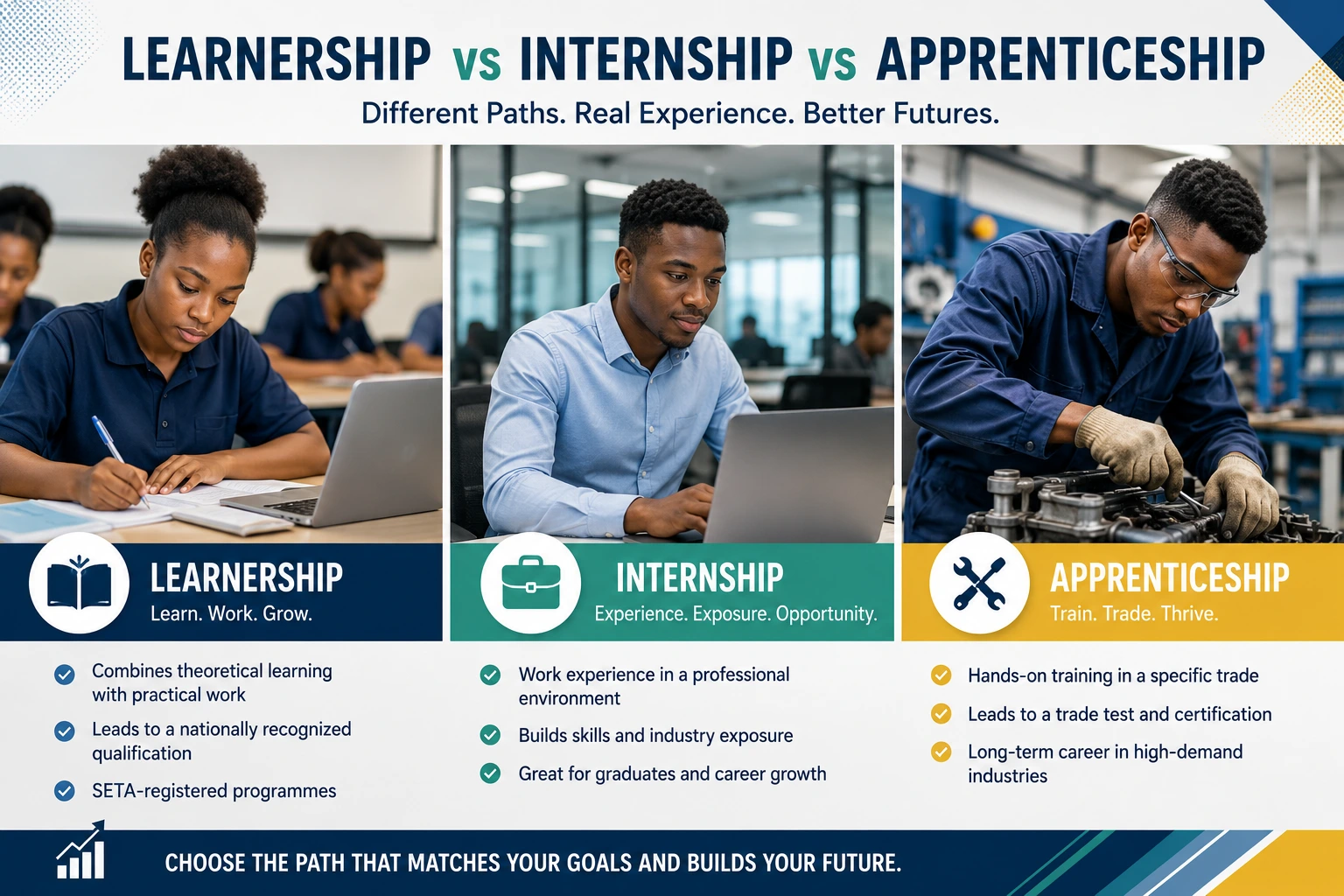
Confused about learnership vs internship vs apprenticeship? This 2026 guide breaks down key differences, benefits, and career impact to help South African job seekers choose wisely.
Introduction: Why Understanding Learnership vs Internship vs Apprenticeship Matters Now
In 2026, South Africa’s employment landscape continues to evolve under pressure from high youth unemployment, skills shortages, and shifting industry demands. For many job seekers—especially recent matriculants and graduates—the choice between a learnership vs internship vs apprenticeship is no longer just academic. It’s a decision that can shape long-term career outcomes.
Government-backed programmes, private sector initiatives, and SETA-funded opportunities are expanding, yet confusion remains widespread. Many applicants apply blindly, not fully understanding what each pathway offers—or demands. The result? Misaligned expectations, missed opportunities, and stalled career progression.
This article provides a detailed, analytical comparison of learnerships, internships, and apprenticeships. It goes beyond definitions to explore real-world implications, labour market relevance, and strategic career positioning in South Africa today.
ALSO APPLY FOR City of Tshwane General Worker Jobs 2026: A Rare Opportunity Across Nature Reserves You Shouldn’t Miss
Quick Facts Box About Learnership vs Internship vs Apprenticeship
- Closing date: Not stated in the official advert
- Location: Not stated in the official advert
- Duration: Not stated in the official advert
- Positions available: Not stated in the official advert
- Reference number: Not stated in the official advert
- Stipend: Not stated in the official advert
- Required Gender: Not stated in the official advert
- Name of the Company: Not stated in the official advert
Understanding the Core Differences in Learnership vs Internship vs Apprenticeship
At a surface level, all three programmes aim to bridge the gap between education and employment. However, their structure, purpose, and outcomes differ significantly.
A learnership is a structured programme that combines theoretical learning with practical workplace experience. It is typically registered with a Sector Education and Training Authority (SETA) and leads to a nationally recognized qualification aligned with the National Qualifications Framework (NQF).
An internship, by contrast, is primarily work-based. It focuses on giving graduates exposure to real workplace environments, often without a formal qualification at the end. Internships are common in corporate sectors such as finance, marketing, and administration.
An apprenticeship is more technical and trade-focused. It involves long-term, hands-on training in fields like plumbing, electrical work, or mechanics. Apprenticeships often culminate in a trade test and certification.
From a structural perspective: Learnership vs Internship vs Apprenticeship
- Learnership = education + work + qualification
- Internship = work experience + exposure
- Apprenticeship = technical training + trade certification
Understanding this distinction is essential because it directly influences employability and career direction.
Accessibility and Entry Requirements: Who Each Pathway Is Designed For || Learnership vs Internship vs Apprenticeship
One of the most critical factors in the learnership vs internship vs apprenticeship debate is accessibility.
Learnerships are generally the most inclusive. Many programmes accept candidates with: Learnership vs Internship vs Apprenticeship
- Matric or even lower qualifications
- Limited or no work experience
This makes them particularly valuable for youth entering the labour market for the first time.
Internships, on the other hand, are often reserved for: Learnership vs Internship vs Apprenticeship
- Diploma or degree holders
- Recent graduates seeking industry exposure
This creates a barrier for individuals without formal tertiary education.
Apprenticeships fall somewhere in between. While they may require basic schooling, they place greater emphasis on: Learnership vs Internship vs Apprenticeship
- Technical aptitude
- Willingness to engage in physically demanding work
In practical terms, this means: Learnership vs Internship vs Apprenticeship
- Learnerships widen access
- Internships reward academic progression
- Apprenticeships target skill-specific careers
This segmentation reflects broader labour market dynamics, where different pathways serve different segments of the population.
Financial Incentives and Economic Value: What Do You Really Earn?
A major concern for applicants is income. While all three pathways offer some form of financial support, the structure and value differ.
Learnerships typically provide a monthly stipend. This is not a full salary but is designed to cover basic living expenses. The stipend is often funded through SETA grants, making it relatively consistent across sectors.
Internships may offer:
- A stipend (common in government programmes)
- A salary (in private sector roles)
- Or, in some cases, no pay at all
This variability can make internships less predictable financially.
Apprenticeships usually provide the most stable income among the three. Apprentices are often treated as employees in training, receiving:
- Regular wages
- Incremental increases as skills develop
From an economic standpoint:
- Apprenticeships offer the strongest earning potential during training
- Learnerships provide moderate, structured financial support
- Internships vary widely depending on the employer
This financial dimension is often overlooked but plays a crucial role in decision-making, especially for individuals supporting themselves or their families.
Career Outcomes and Employability: Which Pathway Leads to Jobs?
The ultimate goal of any programme is employment. However, the outcomes differ significantly across the learnership vs internship vs apprenticeship spectrum.
Learnerships enhance employability by:
- Providing a recognized qualification
- Offering practical experience
- Aligning with industry standards
However, they do not guarantee employment. Success often depends on performance and market demand.
Internships are highly valuable for networking and exposure. Many companies use internships as a recruitment pipeline, meaning top-performing interns may secure permanent roles.
Apprenticeships, however, stand out for their direct link to employment. Skilled trades remain in demand across South Africa, particularly in sectors like construction, manufacturing, and energy.
In terms of long-term employability:
- Apprenticeships → High demand, skill-based employment
- Learnerships → Broad opportunities, qualification-driven
- Internships → Dependent on industry and performance
This suggests that the “best” option depends largely on career goals rather than a universal standard.
Industry Relevance: Aligning with South Africa’s Economic Needs
South Africa’s economy is undergoing structural changes, with increasing emphasis on:
- Infrastructure development
- Digital transformation
- Green economy initiatives
Each pathway plays a role in supporting these priorities.
Learnerships are widely used in sectors like:
- Banking
- Retail
- Public administration
They support entry-level workforce development.
Internships dominate in:
- Corporate environments
- Government departments
- Professional services
They help transition graduates into formal employment.
Apprenticeships are critical in:
- Engineering
- Construction
- Technical trades
These sectors face ongoing skills shortages, making apprenticeships strategically important.
From a policy perspective, the government continues to promote all three pathways—but with increasing focus on technical skills development. This suggests a growing importance of apprenticeships in the years ahead.
Challenges and Misconceptions: What Job Seekers Often Get Wrong
Despite their benefits, all three programmes come with challenges.
A common misconception is that a learnership guarantees a job. In reality, it improves employability but does not ensure placement.
Internships are often assumed to lead directly to permanent roles. While this can happen, it is not guaranteed—especially in competitive industries.
Apprenticeships, meanwhile, are sometimes overlooked due to perceptions that trade careers are less prestigious. However, this view is increasingly outdated, given the strong demand for skilled artisans.
Another issue is misalignment. Many applicants choose a pathway based on availability rather than suitability. This can lead to:
- Low engagement
- Poor performance
- Limited career progression
A more strategic approach is needed—one that aligns personal strengths with market demand.
What This Means Going Forward-Learnership vs Internship vs Apprenticeship
The comparison of learnership vs internship vs apprenticeship reveals a broader shift in how South Africa is addressing employment challenges.
Looking ahead, several trends are likely:
1. Increased Integration of Work and Learning
Programmes will continue blending education with practical experience, making hybrid models more common.
2. Greater Emphasis on Technical Skills
As infrastructure and industrial sectors expand, apprenticeships will become more prominent.
3. Competitive Internship Landscapes
With more graduates entering the market, internships will become increasingly competitive and selective.
4. Expansion of Learnership Opportunities
Government and private sector partnerships are likely to increase learnership availability, especially in entry-level roles.
5. Data-Driven Recruitment
Employers will increasingly use performance data from these programmes to identify top talent.
For job seekers, this means that choosing the right pathway is no longer optional—it’s strategic. Understanding where each option leads can significantly influence long-term success.
FAQs-Learnership vs Internship vs Apprenticeship
1. Which is better: learnership, internship, or apprenticeship?
There is no single “best” option. Learnerships are ideal for gaining qualifications, internships for exposure, and apprenticeships for technical careers.
2. Can I do a learnership after an internship?
Yes, it is possible. Many individuals move between programmes depending on their career goals and available opportunities.
Conclusion-Learnership vs Internship vs Apprenticeship
The debate around learnership vs internship vs apprenticeship is not about choosing the “easiest” path—it’s about selecting the most appropriate one for your career goals, qualifications, and personal circumstances.
Each pathway serves a distinct purpose within South Africa’s labour market. Learnerships open doors for entry-level candidates, internships bridge the gap for graduates, and apprenticeships build the technical backbone of the economy.
Understanding these differences is essential. In a competitive job market, informed decisions are often the difference between stagnation and progress.









Leave a Reply