

Discover the hidden learnership requirements most South African applicants overlook in 2026. Learn how employers evaluate candidates beyond qualifications and why many applications fail.
Every year, thousands of South Africans apply for learnership opportunities hoping to gain workplace experience, accredited training and a pathway into formal employment. Yet despite meeting the advertised requirements, many applicants never progress beyond the first screening stage.
This growing frustration has led many young people to ask the same question: Why do some candidates succeed while others with similar qualifications get rejected?
The answer often lies in the hidden realities behind learnership requirements — factors that are rarely explained clearly in official adverts but heavily influence recruitment decisions.
In 2026, South Africa’s learnership environment has become significantly more competitive. Rising unemployment, digital recruitment systems and employer expectations have transformed how organisations evaluate applicants. Meeting the minimum criteria alone is no longer enough in many cases.
Today, companies increasingly assess: Hidden Learnership Requirements in South Africa
- workplace readiness,
- communication ability,
- digital literacy,
- professionalism,
- behavioural traits,
- administrative accuracy,
- adaptability.
This means many unsuccessful applicants are not necessarily underqualified academically. Instead, they may lack awareness of the practical and behavioural expectations shaping modern learnership recruitment.
Understanding these overlooked requirements has become critically important for young South Africans navigating an increasingly competitive training and employment landscape.
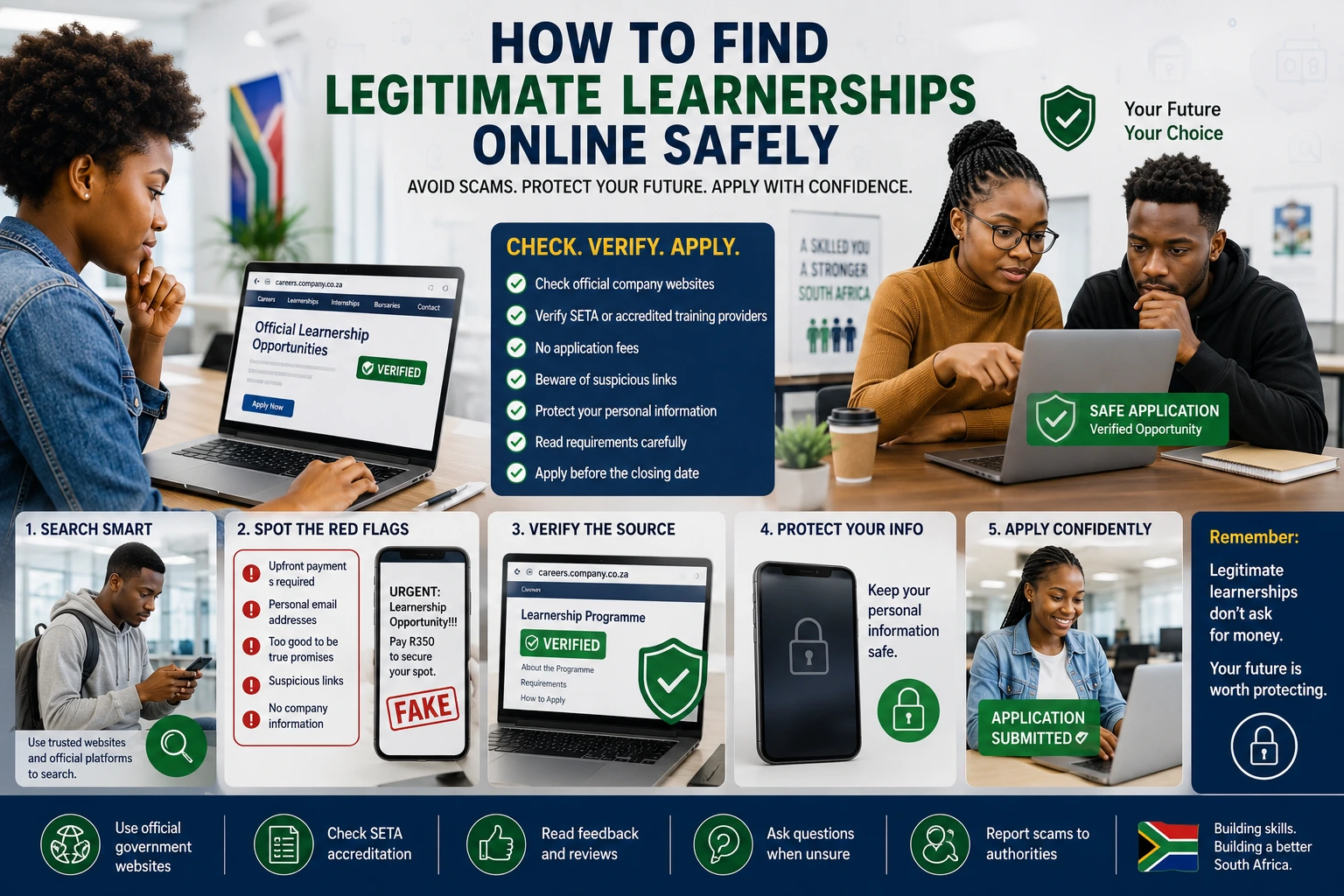
ALSO READ 7 Critical Ways to Find Legitimate Learnerships Online in South Africa Before Scammers Trap You
ALSO READ Complete Guide to Learnerships in South Africa: How They Work and Why They Matter in 2026
Quick Facts About Hidden Learnership Requirements in South Africa
| Item | Details |
|---|---|
| Topic | Learnership Requirements: What Most Applicants Don’t Know |
| Location | South Africa |
| Programme Type | Learnership and Workplace Training |
| Duration | Varies by programme |
| Positions Available | Not stated in the official advert |
| Closing Date | Varies by employer |
| Reference Number | Not stated in the official advert |
| Stipend | Depends on the employer or SETA |
| Required Gender | Not stated in the official advert |
| Company Name | Multiple employers and SETAs |
Why Learnership Requirements Are Becoming More Complex-Hidden Learnership Requirements in South Africa
One of the biggest misconceptions among applicants is the belief that learnership recruitment focuses only on qualifications such as Grade 12 certificates or tertiary studies.
While educational requirements remain important, employers increasingly use learnerships to identify future employees capable of adapting to modern workplaces.
This shift is happening because companies face growing operational pressures including: Hidden Learnership Requirements in South Africa
- digital transformation,
- customer service expectations,
- compliance standards,
- productivity demands,
- teamwork requirements.
As a result, learnership programmes are no longer viewed simply as social development initiatives. Many organisations now treat them as long-term talent pipelines.
This means employers want candidates who demonstrate: Hidden Learnership Requirements in South Africa
- reliability,
- professionalism,
- communication skills,
- willingness to learn,
- workplace maturity.
Consequently, applicants who only focus on academic qualifications may overlook the deeper expectations influencing recruitment decisions.
Minimum Requirements Are Often Only the Starting Point-Hidden Learnership Requirements in South Africa
Many learnership adverts state relatively simple entry requirements such as: Hidden Learnership Requirements in South Africa
- Grade 12,
- unemployment status,
- South African citizenship,
- computer literacy.
However, these criteria usually represent the minimum eligibility threshold rather than the full selection standard.
In practice, employers may receive thousands of applications for a limited number of positions. This forces recruiters to identify additional ways of filtering candidates.
Applicants who stand out often demonstrate: Hidden Learnership Requirements in South Africa
- stronger CV presentation,
- better communication,
- organised documentation,
- clearer career interest,
- professionalism during interactions.
For example, two applicants may both hold matric certificates, but recruiters may favour the candidate who: Hidden Learnership Requirements in South Africa
- submits a well-structured CV,
- uses a professional email address,
- follows instructions accurately,
- communicates clearly.
This reflects a growing reality within South Africa’s recruitment landscape: administrative professionalism itself has become part of employability.
Digital Literacy Is Quietly Becoming a Core Learnership Requirement-Hidden Learnership Requirements in South Africa

A major trend shaping learnership recruitment in 2026 is the increasing importance of digital literacy.
Even entry-level programmes now frequently involve: Hidden Learnership Requirements in South Africa
- online applications,
- digital assessments,
- virtual communication,
- workplace systems,
- electronic documentation.
Many applicants underestimate how heavily employers evaluate basic digital competence.
Simple issues such as: Hidden Learnership Requirements in South Africa
- incorrect document uploads,
- poorly named files,
- incomplete online forms,
- weak email communication
can negatively affect application outcomes.
Importantly, digital literacy no longer refers only to advanced technical skills. Employers increasingly expect candidates to demonstrate comfort with: Hidden Learnership Requirements in South Africa
- email communication,
- document formatting,
- online portals,
- Microsoft Office,
- digital professionalism.
This matters because modern workplaces across retail, banking, logistics and administration now operate heavily through technology systems.
Candidates who struggle with basic digital tasks may therefore appear less workplace-ready, even when they meet academic requirements.
Behaviour and Attitude Matter More Than Many Applicants Realise
Another overlooked aspect of learnership requirements involves behavioural assessment.
Employers increasingly evaluate:
- attitude,
- accountability,
- teamwork,
- adaptability,
- professionalism.
This shift reflects changing workplace realities where technical skills alone are often insufficient.
Modern organisations operate in collaborative, customer-driven environments requiring employees who can:
- communicate respectfully,
- solve problems calmly,
- follow procedures consistently,
- adapt to pressure,
- work effectively with teams.
As a result, recruiters frequently pay attention to:
- how applicants communicate,
- punctuality during interviews,
- professionalism in messages,
- willingness to learn.
In some cases, behavioural traits may outweigh qualifications when recruiters compare similarly educated candidates.
For example, employers often prefer applicants who demonstrate enthusiasm, professionalism and reliability over candidates with stronger academic backgrounds but weaker interpersonal behaviour.
This is particularly true in customer-facing sectors such as:
- retail,
- hospitality,
- administration,
- call centres,
- banking.
Many Applicants Ignore the Importance of Documentation Accuracy
One of the most common reasons applications fail involves incomplete or incorrect documentation.
Recruiters regularly encounter:
- missing ID copies,
- uncertified documents,
- outdated certifications,
- incomplete CVs,
- incorrect contact details.
These issues may appear minor, but they often signal poor attention to detail.
In operational environments where accuracy matters, documentation mistakes can negatively influence recruiter perceptions.
Importantly, many learnership programmes now use automated filtering systems. Applications missing required documents may be rejected automatically before human review even occurs.
This means applicants should treat administrative accuracy as seriously as qualifications themselves.
Strong applicants typically:
- label documents properly,
- submit clear scans,
- follow instructions carefully,
- double-check information,
- maintain updated records.
As competition increases, organisational discipline may become an increasingly important differentiator.
Employers Increasingly Prioritise Workplace Readiness
One of the hidden realities behind learnership recruitment is that employers are often evaluating future workplace potential rather than immediate productivity.
This explains why programmes frequently emphasise:
- willingness to learn,
- teamwork,
- communication,
- responsibility,
- professionalism.
Companies understand that technical skills can often be taught internally. However, workplace discipline and attitude are more difficult to develop quickly.
The strongest learnership candidates therefore usually demonstrate:
- emotional maturity,
- professionalism,
- reliability,
- adaptability,
- learning potential.
This shift also reflects broader labour market trends where employers seek employees capable of adapting to rapidly changing operational environments.
For example:
- retail businesses require customer-focused workers,
- logistics companies need accuracy and reliability,
- administrative environments prioritise organisation and communication.
Learnerships increasingly function as extended workplace evaluations rather than purely educational programmes.
Soft Skills Are Becoming Economic Assets
South Africa’s labour market is changing in ways many applicants underestimate.
Technical qualifications remain important, but soft skills are becoming increasingly valuable because they support:
- customer experience,
- operational efficiency,
- workplace collaboration,
- problem-solving.
Employers frequently identify communication and professionalism as major weaknesses among entry-level candidates.
As a result, applicants with stronger soft skills may gain competitive advantages even within technical programmes.
Key soft skills influencing learnership recruitment now include:
- communication,
- teamwork,
- time management,
- professionalism,
- adaptability,
- critical thinking.
Interestingly, these are also the skills least likely to be automated by technology.
As workplaces become more digital, human interaction and collaboration abilities may become even more valuable over time.
The Psychological Pressure of Learnership Competition
Another hidden challenge facing applicants is the psychological impact of highly competitive recruitment environments.
Many young South Africans apply repeatedly without feedback, leading to:
- frustration,
- discouragement,
- rushed applications,
- emotional decision-making.
This pressure sometimes causes applicants to:
- ignore instructions,
- submit incomplete documents,
- fall for scams,
- apply impulsively.
Understanding that competition is extremely high can help applicants adopt more strategic approaches.
Rather than applying randomly to hundreds of opportunities, stronger candidates often:
- target relevant programmes,
- customise applications,
- improve CV quality,
- strengthen digital professionalism,
- prepare documents carefully.
This strategic mindset may improve long-term results more effectively than high-volume applications alone.
What This Means Going Forward
The future of learnership recruitment in South Africa will likely become increasingly competitive and digitally driven.
Several trends are shaping this shift: Hidden Learnership Requirements in South Africa
- rising youth unemployment,
- automated recruitment systems,
- digital workplace transformation,
- employer demand for adaptable workers.
This means learnership requirements may continue expanding beyond formal qualifications toward broader employability indicators.
Applicants who understand these hidden expectations may place themselves at a significant advantage.
In the coming years, successful candidates will likely need to demonstrate: Hidden Learnership Requirements in South Africa
- workplace professionalism,
- digital literacy,
- communication ability,
- organisational discipline,
- adaptability.
At the same time, employers may continue using learnerships strategically to identify future workforce talent rather than simply providing temporary training opportunities.
For young South Africans, employability itself is becoming more multidimensional than ever before.
Practical Tips for Meeting Modern Learnership Requirements-Hidden Learnership Requirements in South Africa
Applicants can improve competitiveness by: Hidden Learnership Requirements in South Africa
- Using professional email addresses
- Preparing organised CVs
- Verifying document accuracy
- Improving communication skills
- Practising interview professionalism
- Building digital confidence
- Applying strategically rather than randomly
Small improvements in professionalism and preparation may significantly influence recruitment outcomes.
FAQs-Hidden Learnership Requirements in South Africa
Why do many applicants get rejected even after meeting learnership requirements?
Many employers evaluate additional factors such as professionalism, communication skills, digital literacy and workplace readiness beyond minimum academic qualifications.
Are computer skills important for learnership applications?
Yes. Most learnership programmes now involve digital systems, online applications and workplace technology, making basic computer literacy increasingly important.
Conclusion-Hidden Learnership Requirements in South Africa
Understanding the hidden realities behind learnership requirements has become essential for young South Africans navigating a highly competitive employment environment. While qualifications remain important, employers increasingly evaluate broader indicators of workplace readiness including professionalism, communication ability, digital literacy and behavioural adaptability.
As recruitment systems become more digital and competitive, successful applicants are often those who approach learnership opportunities strategically rather than relying solely on academic eligibility.
For many candidates, improving employability now involves more than obtaining certificates. It requires developing the practical, organisational and interpersonal skills modern workplaces increasingly demand.




Leave a Reply